
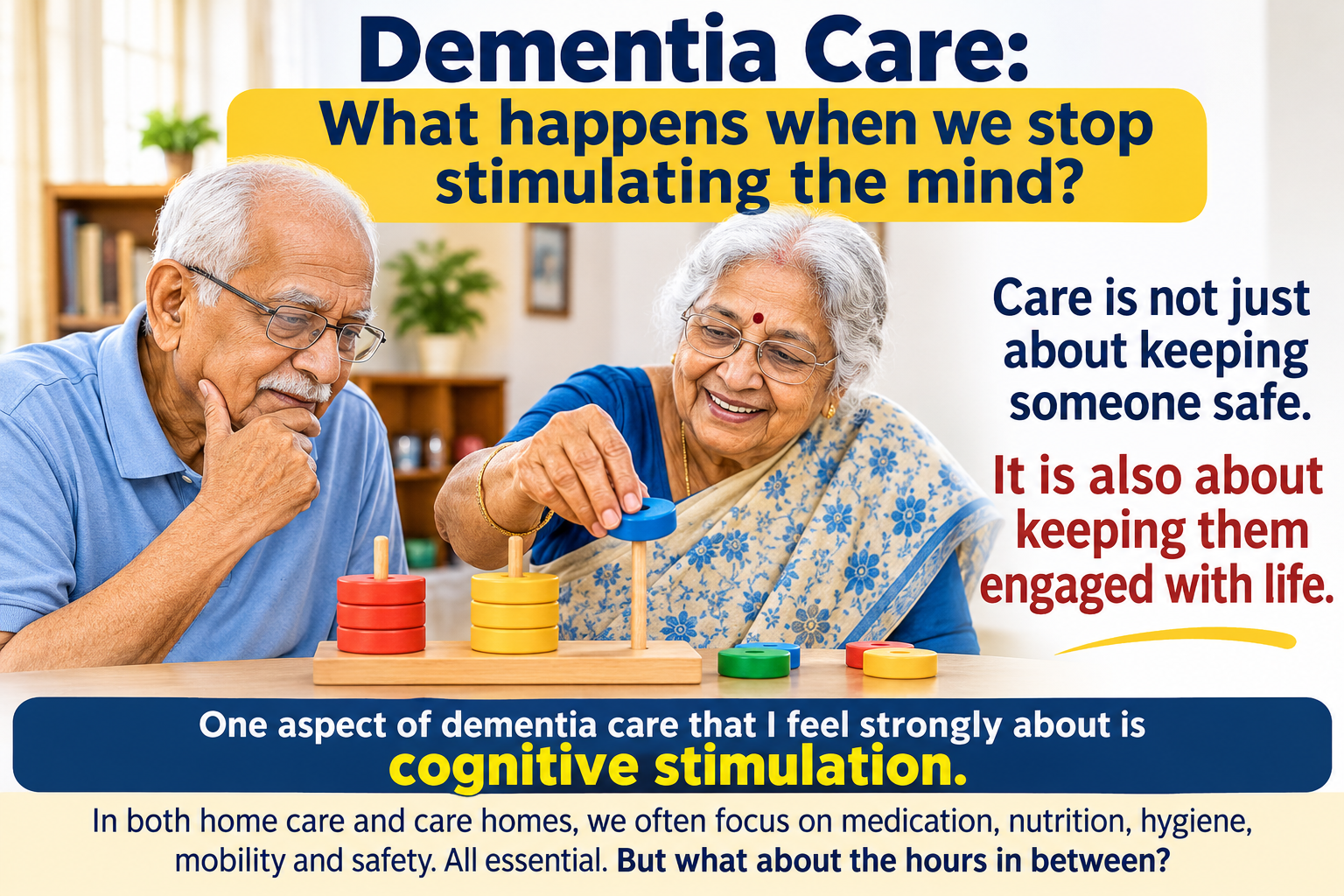
Care is not just about keeping someone safe. It is also about keeping them engaged with life.
One aspect of dementia care that I feel strongly about is cognitive stimulation.
In both home care and care homes, we often focus on medication, nutrition, hygiene, mobility and safety. All essential. But what about the hours in between?
Is the person simply sitting, sleeping or watching television for most of the day?
A person living with dementia may gradually lose memory, communication and independence. But their need for interaction, sensory experiences and human connection does not disappear.
Research, including Cochrane reviews, supports the value of cognitive stimulation and personalised activities in dementia care. These interventions can offer modest cognitive and quality-of-life benefits, and personalised activities may help reduce agitation in some people.
What does cognitive stimulation look like in practice?
* Familiar music and conversations.
* Looking at family photographs.
* Simple sensory activities.
* Reminiscence and storytelling.
* Familiar household based chores.
* Opportunities to make simple choices.
At 50 Plus Assist, we see this in our work with Mr. Burman, who is living with advanced dementia for past 7 years .
We don’t approach stimulation as a memory test. We don’t expect him to answer questions or complete activities.
We focus on what he can still experience, recognise and respond to. Sometimes a familiar voice, music or a simple interaction becomes an opportunity for engagement.
We respect his responses and adapt accordingly.
One practice I believe every care home and home-care provider should introduce is COGNITIVE CARE CALENDARING.
Just as we schedule medication, meals and personal care, we should schedule meaningful cognitive engagement throughout the day.
Not as a rigid timetable, but as a personalised daily plan that caregivers can follow, document and adapt.
Because if stimulation is left to ‘whenever we have time’, it often doesn’t happen.
My belief is simple:
No stimulation should never become the default approach to dementia care.
We may not be able to restore lost memories, but we can create meaningful moments in the present.
And perhaps that is one of the most important responsibilities we have as dementia-care professionals.
Don’t just care for the person. Continue to engage with the person!
I am Dr.Mrigna Nagraj and my passion is senior care