
Article contributed by: Dr. Shiva Jain Sangoi (PT)
Most families come to me after the fall.
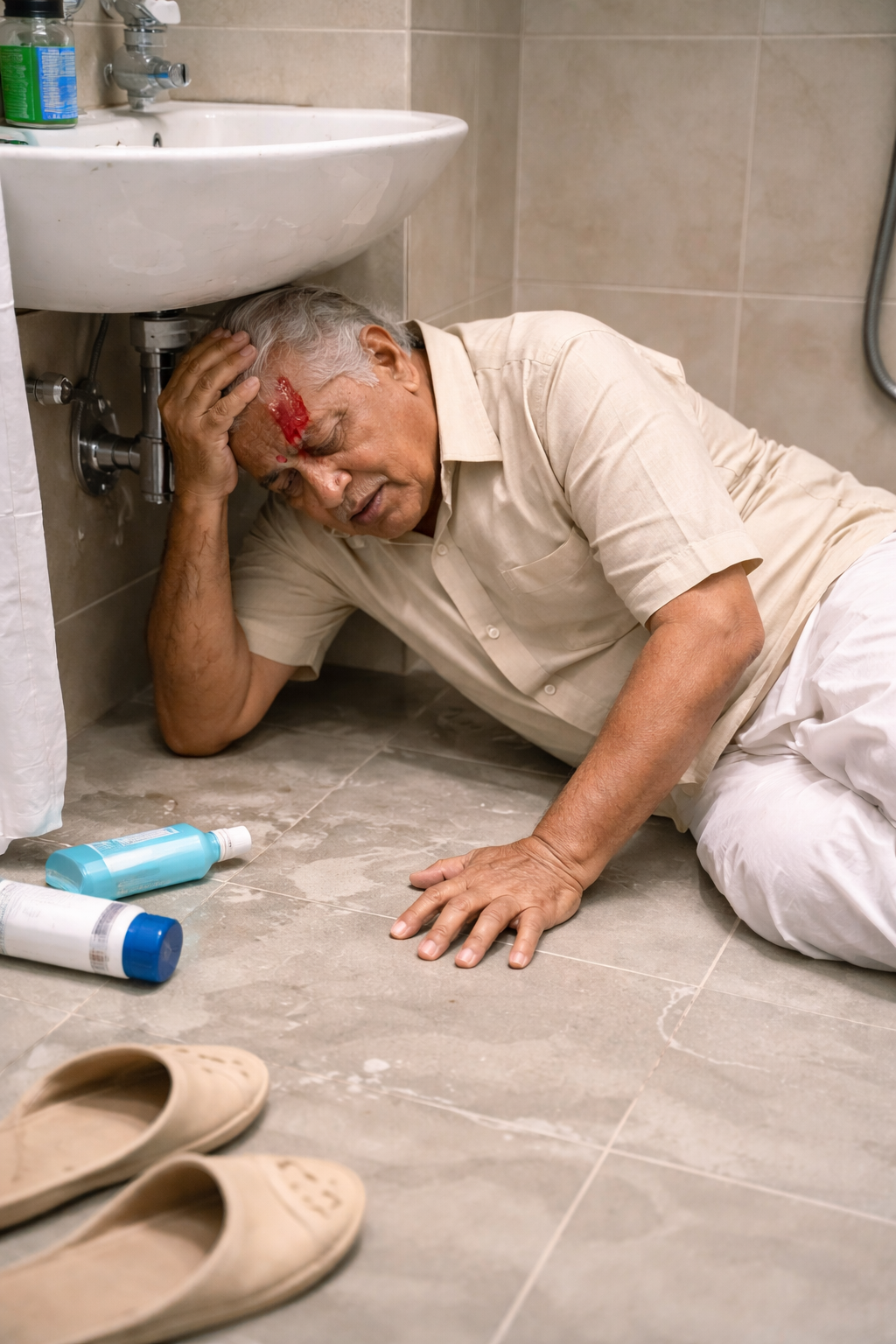
Someone's mother slipped in the bathroom. Someone's father misjudged the step between the hall and the bedroom. The hip is fractured, the surgery is done, and now there is a rehabilitation plan, a walker, and a family rearranging its life around a single afternoon that lasted four seconds.
What is difficult to say gently is this: in a large share of those cases, the hazard had been sitting in that flat for years. Everyone had walked past it a thousand times. It was simply invisible until it wasn't.
So this article is not about what to do after a fall. It is about the walk-through I wish more families would do this weekend, while nothing has happened yet.
Why falls are not a normal part of ageing
There is a belief, widespread and unhelpful, that falling is simply what happens when people get old. It is worth putting down.
Ageing does bring changes that raise risk — muscles lose strength and, importantly, lose power, the ability to produce force quickly. That matters enormously, because recovering from a stumble is a fast movement, not a strong one. Balance reactions slow. Vision changes. Reaction time lengthens.
But none of that makes a fall inevitable. Strength and balance both respond to training at any age, including in the eighties and beyond. And the environment — which is where most falls actually happen — is entirely within a family's control.
The other thing worth knowing: the first fall matters far beyond the injury itself. Even a fall with no fracture often produces a fear of falling, and that fear makes people move less. Moving less weakens exactly the muscles and balance systems that prevent the next fall. It is a loop, and it tightens quietly. Families often notice only that their parent has "become slow" or "doesn't like going out anymore."
The bathroom is where to start
If you change nothing else, change the bathroom. It is the single highest-risk room in an Indian home, and the reasons are specific to how our bathrooms are built and used.
The floor is wet and stays wet. Bucket-and-mug bathing spreads water across the whole floor, not into a contained shower tray. Add soap film to a smooth tile and you have a genuinely slippery surface. Anti-skid mats help. A rubber mat that itself slides is worse than nothing — check that it grips.
There is a step at the door. Almost every Indian bathroom has a raised threshold to keep water in. It is a trip hazard placed precisely where someone is stepping onto a wet surface, often at night, often in a hurry.
There is nothing to hold. Towel rails and soap dishes are not grab bars. They are fixed to tile with small screws and are not designed to take body weight. Proper grab bars, drilled into the wall, cost very little and go in one afternoon. Two are usually enough: one beside the WC, one where your parent stands to bathe.
Getting up from a low seat is hard. If there is an Indian-style toilet and your parent has knee or hip trouble, a raised commode seat or a full conversion is one of the highest-value changes you can make. Rising from a deep squat demands exactly the strength and balance that decline first.
Bathing while standing is a balance task. A plastic stool of the right height — knees roughly level with hips, feet flat on the floor — removes the risk almost entirely and is more dignified than it sounds.
Then walk the route from bed to bathroom
Most night falls happen on this route. Walk it yourself, in the dark, the way your parent does at two in the morning.
Is there any light? A single plug-in night light in the corridor is a small, unglamorous intervention that prevents a great many falls. Many older adults get up two or three times a night, half-asleep, with eyes that adapt to darkness more slowly than they used to.
Is the path clear? Charging cables, a stool, a stack of newspapers, a suitcase that never went back to the loft. Clear the whole route permanently, not just when guests come.
Are there loose mats? Doormats and small rugs at thresholds are a common culprit — the edge lifts, the foot catches. Either fix them down or take them away.
Are the thresholds between rooms visible? Those raised marble strips between hall and bedroom are difficult to see in poor light, especially for eyes managing cataracts or bifocals.
Is the bed the right height? Too low and rising is a struggle; too high and there is a drop. Feet should reach the floor comfortably when sitting on the edge.
The rest of the flat, quickly
The kitchen. Things stored above shoulder height mean climbing. If your parent is standing on a plastic stool or a chair to reach the top shelf, move the daily-use items down to waist height today. Also check for a wet patch by the sink that nobody wipes.
Stairs and building common areas. A handrail on one side only is a problem going down, when the useful hand may be on the other side. If it is a housing society matter, it is worth raising — most societies will fix a second rail if asked.
Balconies and washing areas. Usually wet, often with a step, frequently the least-lit part of the flat.
Footwear. Loose rubber chappals slide off. Bare feet on wet tile slip. Worn-smooth soles grip nothing. Indoor slippers with a back strap and a textured sole are one of the cheapest useful changes available. Many families spend on equipment and miss this entirely.
The puja room. Sitting on the floor and rising from it is one of the hardest things we ask an ageing body to do. A low chair or a firm cushion is not a compromise of devotion.
The things that are not about the house
Some fall risks live in the body rather than the room, and these need a doctor rather than a hardware shop.
Dizziness on standing. If your parent feels light-headed when getting up from bed or a chair, mention it to their physician. It can relate to blood pressure or to medication, and it is often correctable. In the meantime, teach the pause: sit up, wait, stand, wait, then walk.
Medications. Several common drug classes — including some for blood pressure, sleep, and anxiety — can affect balance, particularly in combination. A medication review is a reasonable thing to request.
Vision. Uncorrected cataracts, an outdated spectacle prescription, and bifocals on stairs all raise risk. Bifocals in particular distort the view of the step edge when looking down.
Vitamin D and general nutrition. Deficiency is commonly found in older Indian adults, including those who seem to get plenty of sun, and it affects both bone strength and muscle function. It is a simple blood test.
A previous fall. If your parent has already fallen once — even a small one they laughed off — the risk of another is meaningfully higher. That is the moment for a proper assessment, not the moment to wait and watch.
What a physiotherapist adds
Making a home safe removes hazards. It does not make anybody steadier. For that, the body has to be trained, and it can be.
A physiotherapy assessment for fall risk looks at how someone actually moves: how they rise from a chair, how they turn, how steady they are with a narrowed base, how they manage a step, and whether their ankles and hips are contributing what they should. From that, a specific programme follows — usually strength work for the legs and hips, balance training that is progressed carefully, and practice of the exact movements that have become difficult.
Exercise programmes of this kind are among the better-supported interventions in fall prevention, and they do not require a gym. Most of it can be done at home, and much of it can be supervised on a home visit if travelling is itself part of the problem.
The honest summary is this: a fall is rarely one thing. It is usually a slightly weaker leg, a slightly darker corridor, a slightly wetter floor, and a slightly loose chappal, all arriving in the same second. You cannot control ageing. You can control three of those four.
Walk through the flat this weekend. Look at it as if you had never lived there.
This article is for general information and is not a substitute for individual assessment. Please consult a qualified physiotherapist or doctor for advice specific to your parent's situation.
About the author
Dr. Shiva Jain Sangoi (PT) is a physiotherapist with BPTh and MPTh (Ortho) qualifications and a FIFA Diploma in Football Medicine, with over ten years of clinical experience and more than 8,000 cases across orthopaedic, post-surgical, and geriatric rehabilitation. A significant part of her practice is home-visit physiotherapy for older adults, including balance and fall-prevention programmes. She practices at PhysioSthanak (https://physiosthanak.com) in Borivali West, Mumbai.