Article Contributed by: Dr. Shiva Jain Sangoi (PT)
The hospital part of a hip fracture is the short part. Surgery, a few days on the ward, a discharge summary, and then everyone goes home — and that is where the real recovery begins, usually with far less supervision than the week that came before it.
In my clinical experience the six weeks after that discharge decide a great deal about the next year. Not because anything dramatic happens in them, but because very small decisions — how often she stands, whether he walks to the bathroom or is carried, whether anyone works the other leg — quietly add up.
I want to describe what actually happens in those weeks, and the four things families most often get wrong. None of this replaces the instructions your surgeon has given you. Weight-bearing rules in particular come from the operating surgeon and from nobody else.
Why six weeks matters so much
An older adult loses strength faster than most families expect. A person who is in bed most of the day loses meaningful leg muscle within the first week or two, and bone and balance follow. The fracture is one injury; the weeks of stillness afterwards are a second one, and the second is the one families have some control over.
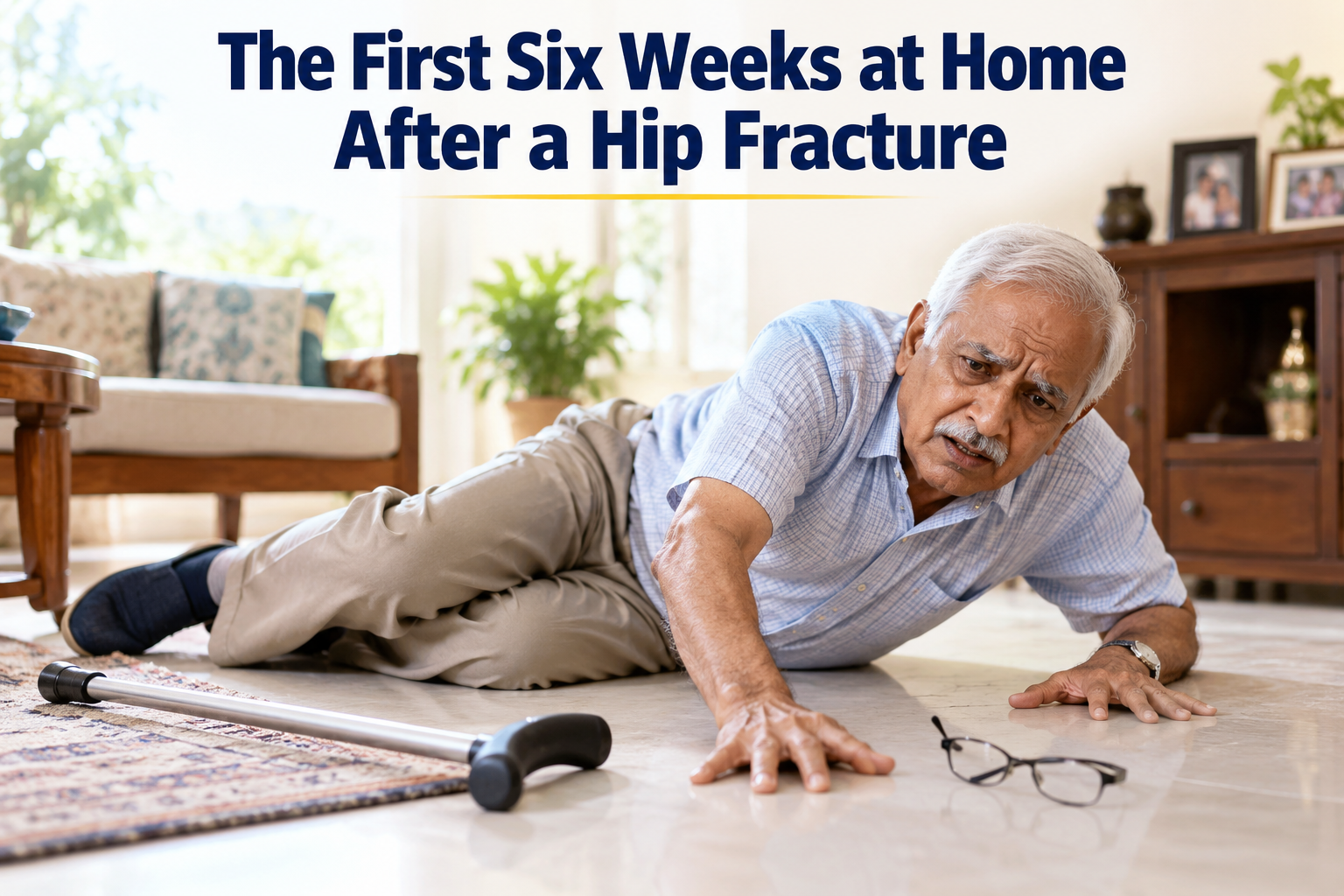
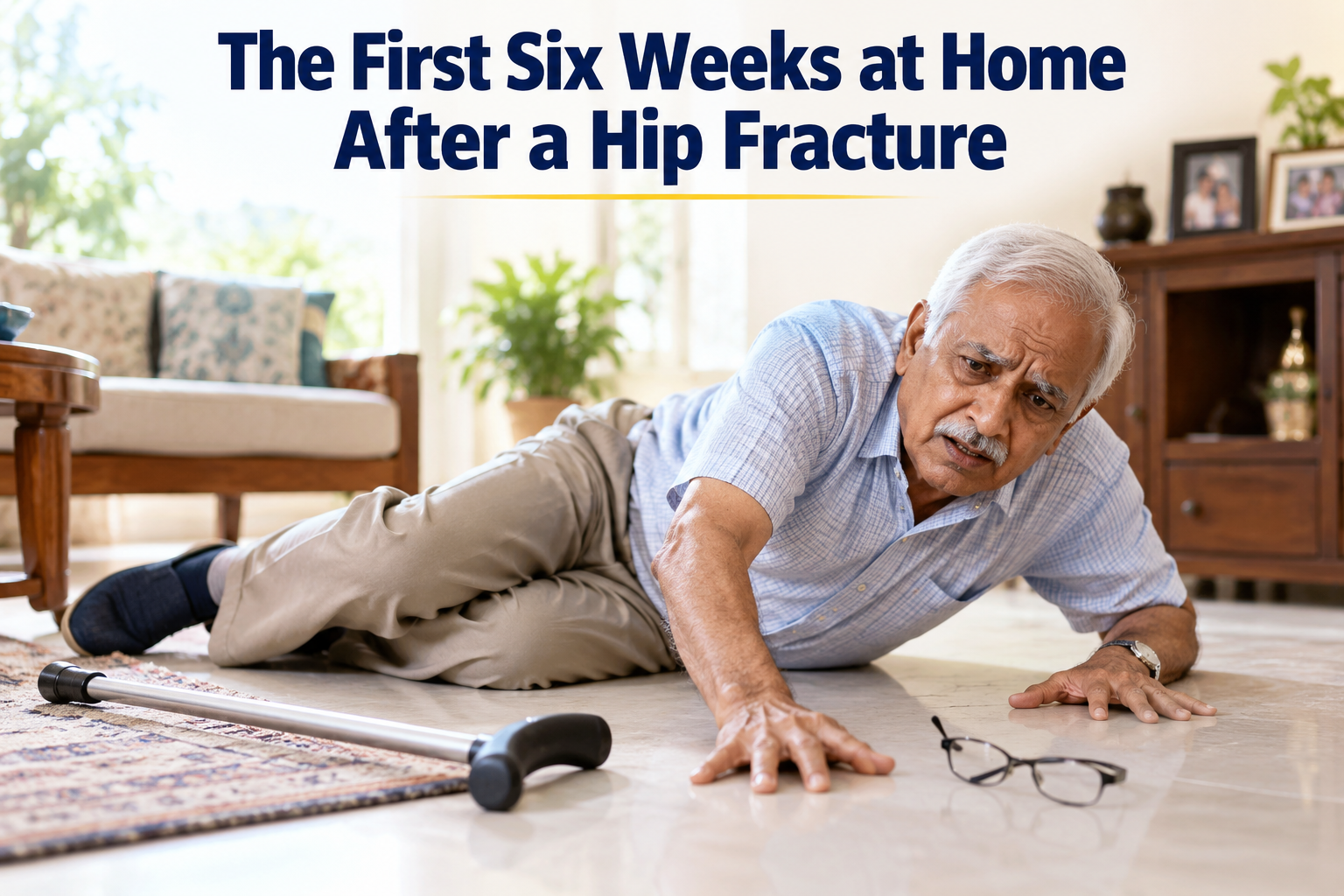
There is also the part nobody writes on the discharge sheet. After a fall and a fracture, most people are frightened of the floor. That fear is rational and it does not go away on its own. It makes the person shuffle, look down, hold furniture, avoid turning — and every one of those habits makes another fall more likely, not less.
Mistake one: treating rest as the treatment
The instinct at home is protective. Let her rest. Do not disturb him. Bring everything to the bed.
Rest is not the treatment; controlled movement is. Depending on the surgery and what the surgeon has permitted, most people are helped up and moving within the first day or two in hospital — and that does not stop at the front door. The goal in week one at home is usually not distance. It is frequency: short, safe, supervised movement several times a day instead of one heroic walk.
When a family tells me the person is resting well, I ask how many times she has been out of bed since morning. The answer is often once.
Mistake two: letting the walker become permanent
A walker after hip surgery is a good tool. It is meant to be a stage, not a destination.
What I see is that once the person is safe with a walker and the household is no longer frightened, progress stops there. Nobody revisits it. Six months later the walker is still in use, the arms are doing work the legs should be doing, and the legs have quietly got weaker underneath.
Progression from walker to stick to independent walking should be a planned, assessed step — done when strength and balance allow it, not when someone feels brave. That assessment is exactly what a physiotherapist is for.
Mistake three: rehabilitating only the broken side
This is the one I feel most strongly about, because it is where my whole approach sits.
A hip fracture is almost never only a hip problem. There was a reason the person fell. Very often it is a combination — weak hip and buttock muscles, poor ankle control, stiffness that has been building for years, eyesight, blood pressure that drops on standing, footwear, a dark passage at night. If rehabilitation treats only the operated hip and ignores the rest, you have repaired the consequence and left the cause exactly where it was.
So the other leg gets trained. The core gets trained. The ankles and the way the feet meet the floor get looked at. And the home gets looked at, because the strongest hip in the world does not help on a wet bathroom floor with nothing to hold.
Mistake four: managing the pain but not the fear
Pain is asked about at every follow-up. Fear almost never is.
The practical answer is not reassurance. It is graded exposure — letting the person do the frightening thing in a safe, supported, boring way, many times, until the nervous system stops treating it as a threat. Standing up from a chair. Turning around. Stepping over the bathroom threshold. Walking without staring at the floor. Small, repeated, supervised.
What honest progress looks like
I do not give guaranteed timelines, and I would be careful of anyone who does. Recovery after a hip fracture depends on the fracture, the surgery, the strength the person had before the fall, their other medical conditions, and how much of the work actually gets done between visits.
What I can say is what good progress looks like: more time on the feet each week, less reliance on the arms, sitting down with control instead of dropping, and a person who stops asking to be carried. If, several weeks in, none of those things is moving, that is worth raising rather than waiting out.
A personal note
When I was in school my father had a serious accident. He lost a great deal of weight, he spent twenty days in a wheelchair, and I was the one wheeling him around the hospital. I learned something then that I still use: the family is not an audience to the recovery. The family is part of the treatment team, and the work between appointments matters more than the appointments.
Dr. Shiva Jain Sangoi (PT) is a physiotherapist at PhysioSthanak, Borivali West, Mumbai — physiosthanak.com