Contributed by: Dr. Shiva Jain Sangoi (PT)
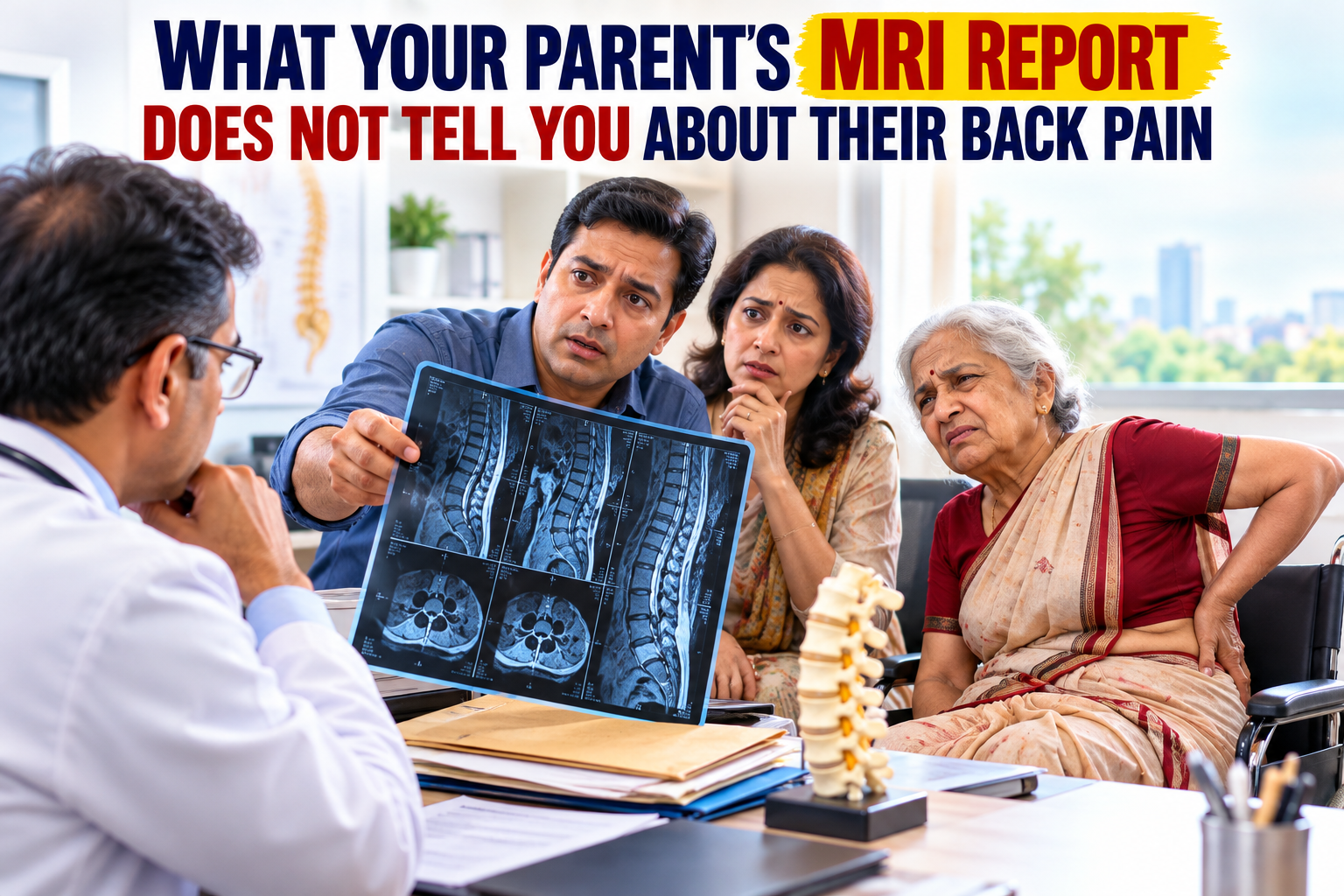
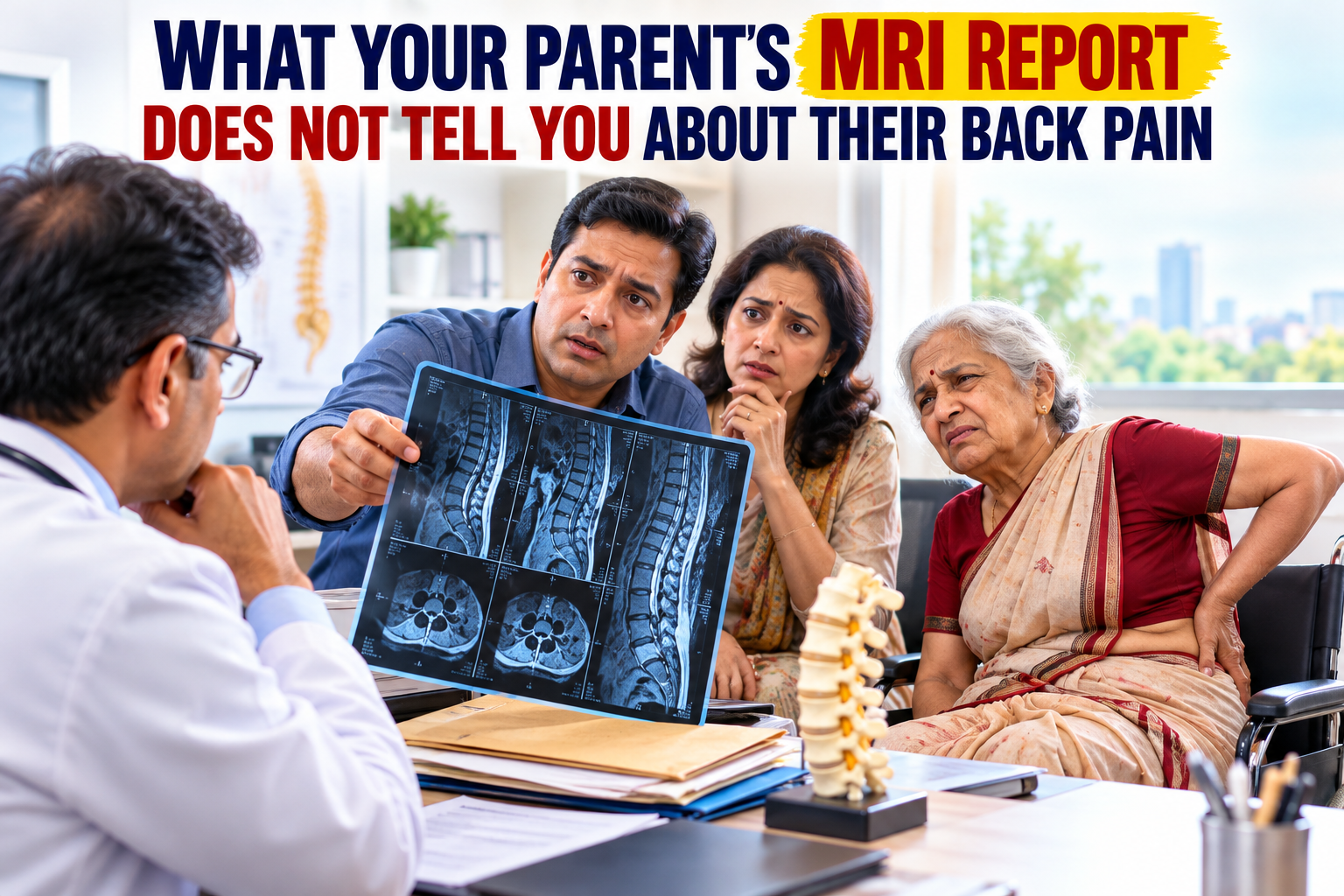
Almost every family who comes to me with an elderly parent's back pain arrives holding a folder. The MRI is usually on top, sometimes still in the hospital envelope. It is handed to me before anyone has sat down properly.
I do not read it straight away. I put it to one side and talk to the parent first.
This is not a dramatic gesture, and it is certainly not because scans do not matter. It is because the report answers a question nobody asked. It describes what the spine looks like. It does not describe what the person can and cannot do, which is the thing the family actually came about.
What the report is really telling you
Open most MRI reports of a spine after sixty and you will find a similar set of phrases: disc desiccation, disc bulge, reduced disc height, facet joint changes, mild canal narrowing. The words sound alarming, especially read at eleven at night on a phone.
Here is the part that rarely gets explained. Those same findings turn up in large numbers of people of that age who have no back pain at all, who walk every morning and have never seen a physiotherapist. A spine at seventy does not look like a spine at twenty, in the same way a seventy-year-old's hands and skin do not. The scan is reporting the passage of time as faithfully as it reports a problem, and it has no way of telling the two apart.
So a report can be entirely accurate and still not identify the cause of this month's pain.
The questions a scan cannot answer
When I assess an older adult with back pain, almost everything that changes my plan comes from the person, not the film.
What was happening when it started. Was it one specific moment, or did it creep in over a few weeks? Pain that began the day after lifting a grandchild behaves differently from pain that arrived quietly over a monsoon.
What makes it worse, and what makes it better. Which positions are pain free? This matters more than most families expect. If there is any position at all that gives relief, we have something to build on.
What time of day it is worst. Morning stiffness that eases with movement tells me something quite different from pain that builds through the afternoon and peaks by evening.
How far they can walk, honestly. Not the distance they say they can manage, but the distance before they start looking for somewhere to sit. That number is often the single most useful thing I learn.
Whether this is a mechanical problem at all. Part of a first assessment is ruling out the things that are not a physiotherapy problem, and referring on when they are.
Then there is the half of the picture that never appears in any report: the chair your father spends six hours a day in, the mattress that sagged three years ago, the footwear he has worn since retirement, whether there is a backrest where he actually sits rather than where guests sit, how much water he drinks, what his hips and ankles can still do, how his knees load when he stands up.
I screen all of it, along with strength in the glutes, hip flexors and thighs, spinal ranges, reflexes and sensation, and the alignment of the pelvis. Only after that do I open the folder.
Why the painful part is often not the guilty part
A patient of mine, a man in his late twenties, came in with knee pain after a trek. Everything pointed at the knee. I assessed him from the shoulders down anyway, which is routine, and found a shoulder injury from two years earlier that had never been properly rehabilitated, along with a hip that had lost its inward rotation. The chain above the knee had stopped doing its share, so the knee was absorbing load that was never meant to reach it. He told me afterwards that he had no idea a shoulder could cause that much trouble somewhere else.
He was twenty-eight. The principle does not change at seventy-eight, and if anything it matters more, because an older spine is being asked to compensate for stiffer hips, weaker glutes, a more cautious walking pattern and often a painful knee on one side. The spine is frequently where the complaint lands, not where it begins. An MRI of the lumbar spine, by definition, cannot see any of that.
What families can do before the appointment
You do not need medical knowledge to make an assessment far more useful. Before you take your parent to anyone, write down four things:
1. The onset story, in their words, with a rough date.
2. Two or three positions or activities that reliably make it worse, and any that make it better.
3. The honest walking distance, and whether the pain travels down a leg.
4. A photograph of where they actually sit, and of the shoes they wear most days.
Bring the reports too. Reports last does not mean reports never. A scan is genuinely valuable once there is a clinical picture to read it against, and there are findings that change a plan completely. The order is what matters. Read first, the report tends to decide what everyone looks for, including the clinician. Read last, it either confirms what the examination already found, or raises a question worth chasing.
One more thing worth saying plainly. Sudden severe back pain after a fall, pain with fever or unexplained weight loss, numbness around the groin, or any new difficulty controlling the bladder or bowel is not a wait-and-watch situation. That needs a doctor the same day, not an exercise plan.
For everything else, the most useful hour you can give an ageing parent in pain is not another scan. It is somebody willing to put the folder down and ask them where it hurts, when, and what they have stopped doing because of it.
Author note: Dr. Shiva Jain Sangoi (PT), physiotherapist at PhysioSthanak, Borivali West - physiosthanak.com; MPTh (Ortho), BPTh, FIFA Diploma in Football Medicine